Thad Beaumont—George Stark
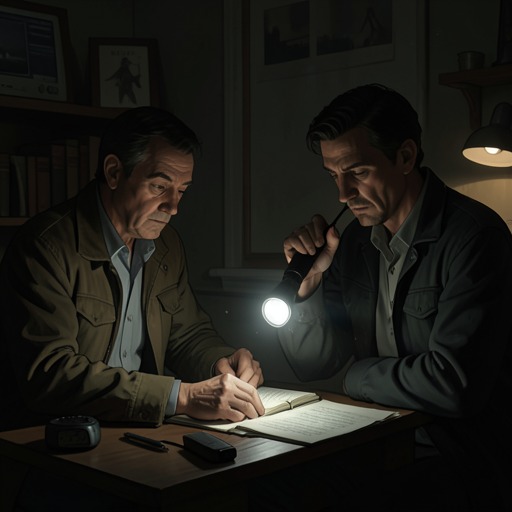
The Dark HalfThad Beaumont—George Stark is a relationship in which the boundary between author and fictional creation becomes physically porous. George Stark is not merely a pen name or an imagined opponent: he is a decaying, embodied double, and Thad understands them as twins, halves of one whole. Their connection carries knowledge, sensation, and action across distance; it can pull Thad toward Stark, make injuries echo between them, and transform writing from a private act into a contest over life. The bond is at once kinship and threat: Stark wants Thad’s help to become alive again, while Thad must find a way to protect his family without allowing his double to take his place.
A double made through writing
The relationship begins in the paradox of creation. Thad’s writing gave George Stark a fictional existence, but Stark’s emergence makes the distinction between a made character and a living person untenable. Thad eventually calls him a ghost, though not an ordinary one: the explanation offered by Dr. Pritchard is that, during a childhood operation, what was removed from Thad’s head was Stark. Alan Pangborn passes that account on to Thad and Liz, connecting the present danger to an earlier physical division inside Thad’s brain. The disclosure recasts their conflict as more than a clash between a writer and an escaped character. Stark is also the surviving counterpart of a twin whom Thad’s body once absorbed.
That origin does not make their identities interchangeable in a simple way. Thad can recognize the tie and still resist what Stark demands; Stark, meanwhile, seeks to reverse his condition. When Alan wonders whether revenge is Stark’s motive, Thad answers that Stark wants not to be dead anymore, and that Thad may be the only person able to make that possible. Stark’s violence therefore grows out of a desire for renewed life, but that desire does not soften its danger: he can make others suffer, and Thad fears that Stark’s escape from death may require the destruction or appropriation of his living counterpart.
Knowledge, distance, and shared sensation
The bond lets Stark know things that ordinary surveillance cannot fully explain. When Stark calls while police tap-and-trace equipment is in place, Thad knows that Stark has waited for the equipment to be installed. He experiences their tie as an invisible connection between twins and imagines himself drifting partway along the telephone line toward Stark, meeting him in western Massachusetts rather than reaching his apparent location in New York City. The image turns distance into a misleading measure: the two are separated geographically but joined by a connection that can draw Thad out of himself.
Thad also concludes that Stark’s awareness of him is growing. In his writing, he reasons that if Stark truly wrote the novels, he has known Thad for a long time, and that this knowledge has increased. Stark’s choice of where to telephone reveals how that intimacy operates. He called the Beaumont home when he wanted the police to overhear him, but used Dave’s Market when he wanted to speak privately to Thad. The calls serve different audiences: one sends a message to the police that Stark is finished killing and will not come after Thad’s family; the other lets Stark reach Thad without the same listeners. Stark even anticipates that Thad will be persuaded by the voiceprint evidence, despite expecting the police to reject it. Their mental connection thus functions alongside deliberate communication, making it difficult to separate supernatural knowledge from Stark’s calculated use of what he knows about Thad.
The connection also crosses into bodily experience. While Stark is in an East Village apartment, he dreams that Thad is with him, talking in bed with the intimate familiarity of brothers whispering after lights out. When Stark writes that there are no birds and stabs his own right hand with a Bic pen, Thad, hundreds of miles north, feels the corresponding act as he sweeps a Berol Black Beauty pencil into his left hand. The episode ends with both men waking. Their injuries and gestures make the bond more than shared thought: what one does to his body can register in the other, even when they are far apart and not consciously cooperating.
Writing as exchange and struggle for control
Writing is the bond’s most sustained medium. Thad recognizes that Stark knows where and how to find him, and the two have repeatedly met or merged in connection with Thad’s writing. Their shared authorship does not mean equal control. In a later forced collaboration, Thad understands that the writing is a ritual for passing a kind of baton, an exchange of power. The price Stark demands, he realizes, is Thad’s inward-looking “third eye,” a faculty buried in his brain. For Thad, the apparent literary task is therefore a bodily and existential bargain: saving Liz and the twins may require surrendering the part of himself Stark covets.
The transfer is also figured as a separation and an obscene birth. As Thad returns to his notebook with Rawlie’s bird-call cupped in one hand, he recognizes that part of him still lusts after the book, but that the desire has weakened. The manuscript is no longer his; Alexis Machine belongs with the person who has owned him from the beginning. That recognition makes their collaboration a reversal of the ordinary author–character relation. The character has become a writer in his own right, while the author’s attachment to the work is bound up with the danger of being absorbed by what he created.
The possibility of successful collaboration terrifies Liz for the same reason. She fears that Thad might supply the jump-start Stark needs, allowing his wounds and sores to heal. She imagines that Stark might begin to take over her husband’s face and form, and that the process could later appear in reverse as sores on Thad’s face. Her fear gives the writing bargain a concrete bodily consequence: restoring Stark may not simply return him to life, but may shift the visible and physical signs of their shared identity between the two men.
The bond’s end in the real world
At the final confrontation, Thad tries to make the struggle’s terms explicit. After driving a pencil into Stark’s throat, he says that he is writing the end in the real world. Stark responds by insisting that they write it for everyone, and turns toward the twins with a bloody pencil in one hand and a gun in the other. The exchange exposes the danger in treating their conflict as fiction: words and writing have shaped Stark, but the consequences now unfold through actual bodies and lives.
The sparrows arrive as the supernatural force that breaks Stark’s immediate hold over the scene. Thad understands them as psychopomps, come to escort Stark back to the land of the dead. As the room fills with birds, Thad drops the pencil and retreats toward his children. The birds settle on Stark and strike him in growing numbers, turning the connection that had drawn Thad toward his double into a final separation. The relationship ends not through a simple retraction of authorship, but through a physical contest in which Thad survives, Stark is carried toward death, and the act of writing has been inseparable from the question of which half can remain in the living world.
Narrative significance
Thad and Stark’s bond makes the novel’s conflict between fiction and reality a problem of identity rather than a metaphor at a safe distance. Stark begins as Thad’s created name, yet the operation in Thad’s childhood, their shared sensations, and their struggle over the manuscript give the double an embodied claim on him. Each medium of contact tightens that claim: the telephone carries Thad’s awareness toward Stark, bodily gestures cross hundreds of miles, and writing becomes a transfer of power rather than mere composition.
The twin relation also keeps kinship and antagonism inseparable. Stark can feel like a brother in the intimacy of a dream, yet he threatens Thad’s family and may seek to take over Thad’s face and form. Thad can understand Stark’s wish not to be dead without accepting its cost. Their conflict therefore rests on a difficult distinction: recognizing the other as part of oneself does not mean surrendering one’s life to him. The final escort by the sparrows gives that distinction a material ending, carrying Stark away while leaving Thad to protect the living family around him.